Checked
About Calgary, Alberta: what to know about the city
Calgary, Alberta, Canada
A plain guide to Calgary, Alberta: where it is, how many people live there, how the quadrants work, transit, the economy, chinook winters, hospitals, schools and landmarks.
Key information
Calgary is Alberta's largest city and Canada's third-largest municipality, built where the Bow and Elbow rivers meet in southern Alberta, about an hour's drive from the Rocky Mountains. The 2021 Census counted 1,306,784 people, and the City of Calgary estimates the population reached about 1,558,700 by April 1, 2025.
On this page
Where is Calgary?
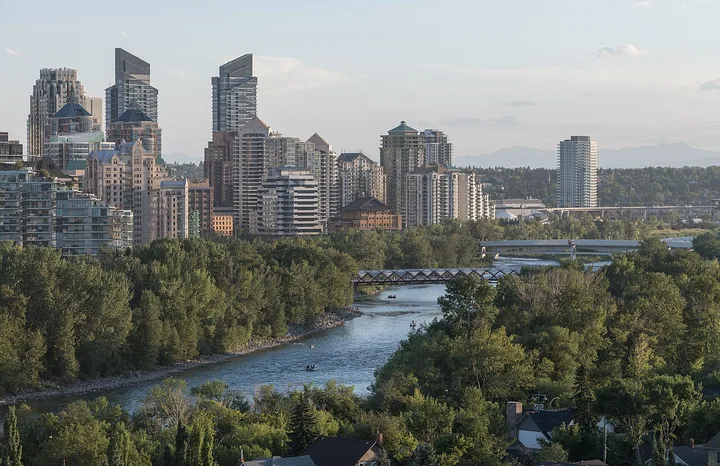
Calgary sits on the Bow River in southern Alberta, about 220 km north of the United States border, at the point where the prairies meet the foothills of the Rocky Mountains. The Elbow River joins the Bow just east of downtown, and two smaller streams, Nose Creek and Fish Creek, also run through the city into the Bow. Those valleys and the bluffs above them shape where neighbourhoods were built.
The City describes the Rocky Mountains as about an hour's drive away, and on clear days they fill the western horizon. The Tsuut'ina Nation's reserve lies along the city's southern edge, and Fish Creek Provincial Park and the Glenmore Reservoir shape the south end of the city.
Indigenous peoples have their own names for this place. In Blackfoot it is Moh-kins-tsis, the Îethka Nakoda Wîcastabi call it Wicispa Oyade, the Tsuut'ina call it Guts-ists-I, and the Métis call the Calgary area Otos-kwunee, according to the City of Calgary's land acknowledgement.
Sources: Calgary, The Canadian Encyclopedia · Our city and land acknowledgement, City of Calgary
How many people live in Calgary?
| Year | Population | What the number is |
|---|---|---|
| 2016 | 1,239,220 | Census count |
| 2021 | 1,306,784 | Census count |
| 2023 | 1,422,200 | City estimate, April 1 |
| 2024 | 1,509,800 | City estimate, April 1 |
| 2025 | 1,558,700 | City estimate, April 1 |
| 2025 | 1,612,834 | Alberta government estimate, July 1 |
| 2026 | 1,583,200 | City forecast, April 1 |
Statistics Canada's 2021 Census counted 1,306,784 people in the City of Calgary, up 5.5 per cent from 1,239,220 in 2016. Growth then sped up sharply. The City's own estimates, which it marks as estimates because no civic census has been held, show the population passing 1.5 million in 2024 and reaching about 1,558,700 on April 1, 2025. Alberta's Office of Statistics and Information, which uses a July 1 date and a different method, puts the 2025 figure higher, at 1,612,834. The City's January 2026 forecast expects slower growth of about 1.6 per cent a year from 2026.
Calgary is a city of newcomers. In 2021, 33.3 per cent of residents were immigrants, and 81,315 recent immigrants arrived between 2016 and 2021, with the Philippines and India the two largest sources. Almost everyone (97.4 per cent) can speak English, and about 40 per cent know at least one language other than English or French. The most common non-official languages spoken at home are Punjabi, Tagalog, Mandarin, Cantonese and Spanish.
Sources: Calgary, The Canadian Encyclopedia · Population profile, City of Calgary · Economic Outlook and Population Outlook, City of Calgary · Municipal population estimates 2016 to 2025, Alberta Office of Statistics and Information
Quadrants and neighbourhoods
Every Calgary street address ends in a quadrant: NE, NW, SE or SW. The same number and street can exist in more than one quadrant, so the two letters matter when you book a delivery or a ride.
Downtown is squeezed between the Bow River and the main railway line. Stephen Avenue (8 Avenue SW), lined with sandstone buildings from Calgary's early boom, was designated a national historic district in 2002. Chinatown sits on the Bow just north of the office towers and is home to the Calgary Chinese Cultural Centre, modelled on Beijing's Temple of Heaven. River neighbourhoods such as Mission, Inglewood and Bowness sit beside the Elbow and Bow, which is why they were among the hardest hit in the 2013 flood.
The University of Calgary and Calgary International Airport are in the north, the Glenmore Reservoir and Fish Creek Provincial Park are in the south, and the main industrial districts lie to the east along the rail lines, including Ogden. Nose Hill Park, one of the city's two very large urban parks along with Fish Creek, covers 1,129 hectares and is ringed by 12 residential communities in the northwest.
Sources: Addressing standards, City of Calgary · Calgary, The Canadian Encyclopedia · Nose Hill Park, City of Calgary · Flood history in Calgary, City of Calgary
How people get around Calgary
Calgary Transit runs a large bus network and the CTrain, a mostly street-level light rail system that opened in 1981. By 2019 the CTrain had two lines, 45 stations and 118.1 km of track, with an average of 312,300 riders a day in 2018. Since 2001 the CTrain has been counted as wind-powered, because the City buys an equal amount of wind-generated electricity. An adult fare is $4.00 and is valid for 90 minutes, and children 12 and under ride free.
Downtown has its own winter trick. The Plus 15 network links office towers, shops and hotels with 86 enclosed bridges and more than 16 km of climate-controlled walkways above street level, so you can cross much of downtown in January without a coat. The first bridge opened in 1969.
The City counts more than 1,000 km of pathways for walking and cycling, many of them along the Bow and Elbow rivers. Calgary International Airport (YYC) is one of the largest and busiest airports in Canada.
Sources: CTrain, The Canadian Encyclopedia · Fares and passes, Calgary Transit · Plus 15 network, City of Calgary · Our city and land acknowledgement, City of Calgary · Calgary, The Canadian Encyclopedia
Calgary's economy and major employers
Calgary is the business capital of western Canada because of oil and natural gas. The first big strike came at Turner Valley, southwest of the city, in 1914, and the 1947 discovery at Leduc turned Calgary into the head office city for the industry. Most of the country's oil and gas producers are headquartered here, including large employers such as Suncor Energy, Enbridge and TC Energy (formerly TransCanada).
That makes the city sensitive to oil prices: Calgary tends to boom when prices are high and struggle when they fall. Over time the economy has added finance, transportation and logistics, film and television, technology, agriculture and food processing. The City says Calgary has the highest concentration of head offices in Canada and the highest GDP per person of the country's major cities. Its fall 2026 outlook expects growth to be slower than in recent years but stronger than first forecast.
Rail is part of the story too. Canadian Pacific has freight yards at Alyth and repair shops at Ogden, and Canadian National runs container and intermodal services from its Sarcee yards.
Sources: Calgary, The Canadian Encyclopedia · Our city and land acknowledgement, City of Calgary · Economic Outlook and Population Outlook, City of Calgary
Weather and climate in plain numbers
| Month | Average daily high | Average daily low | Precipitation |
|---|---|---|---|
| January | -0.9°C | -13.2°C | 9.4 mm |
| April | 11.2°C | -2.0°C | 25.2 mm |
| July | 23.2°C | 9.8°C | 65.5 mm |
| October | 11.7°C | -1.4°C | 15.3 mm |
| Whole year | 10.8°C | -1.9°C | 418.8 mm (128.8 cm of snow) |
Calgary is dry, sunny and changeable. At the airport, the average January day reaches about minus 1 degree Celsius and falls to about minus 13 overnight, while the average July day reaches 23 degrees and cools to about 10 at night. The city gets only about 419 mm of rain and melted snow a year, and June is the wettest month. Snowfall averages about 129 cm a year, but it rarely stays long.
The reason is the chinook, a warm, dry westerly wind that pours down from the Rockies. In southwestern Alberta about one winter day in three is a chinook day. Temperatures can jump very fast when one arrives: a rise of 27 degrees in two minutes has been observed in the chinook belt. Many Calgarians love the break from the cold, while some say the sudden pressure changes give them headaches.
Sources: Canadian Climate Normals 1981 to 2010, Calgary International Airport, Environment and Climate Change Canada · Chinook, The Canadian Encyclopedia
Hospitals, colleges and universities
Five Calgary hospitals have 24-hour emergency departments, according to Alberta Health Services: Foothills Medical Centre, Peter Lougheed Centre, Rockyview General Hospital, South Health Campus and Alberta Children's Hospital. The Sheldon M. Chumir Health Centre downtown and several community health centres handle other care. For anything that is not an emergency, Health Link 811 gives nurse advice by phone at any hour.
The University of Calgary, founded as an independent university in 1966, has 14 faculties and four campuses. Other post-secondary schools include the Southern Alberta Institute of Technology (SAIT), Mount Royal University, Bow Valley College and the Alberta University of the Arts. Most children attend schools run by the Calgary Board of Education or the Calgary Catholic School District; the school registration guide explains how to sign up.
Sources: Calgary Zone facilities map, Alberta Health Services · About the University of Calgary · Calgary, The Canadian Encyclopedia
Landmarks and what Calgary is known for
| Landmark | What it is | Good to know |
|---|---|---|
| Calgary Tower | Observation tower downtown, opened 1968 | 191 metres high, with a glass floor added in 2005 |
| Stampede Park and the Scotiabank Saddledome | Home of the Stampede and the Calgary Flames | The Saddledome was built for the 1988 Olympics |
| Peace Bridge | Pedestrian and cycling bridge over the Bow | Designed by Santiago Calatrava, opened in March 2012 |
| Central Library | Main branch of Calgary Public Library | Opened November 1, 2018, with the CTrain passing through the site |
| Historic City Hall | Sandstone city hall with a clock tower | Opened in 1911, a National Historic Site |
| The Confluence Historic Site and Parkland | Site of Fort Calgary where the Bow and Elbow meet | Renamed from Fort Calgary in 2024 |
| Nose Hill Park | Natural grassland park in the northwest | 1,129 hectares with views of the Rockies |
| WinSport and the Olympic Oval | 1988 Olympic venues still used for training | Ski jumping, bobsleigh and speed skating |
Ask anyone what Calgary is known for and the answer is usually the Calgary Stampede, the 10-day rodeo and exhibition held each July that bills itself as the Greatest Outdoor Show on Earth. The city is also known for the energy industry, the 1988 Winter Olympics, its chinook winters and its long rivalry with Edmonton, which plays out in hockey, football and politics.
Sources: Calgary Stampede, The Canadian Encyclopedia · Tower history, Calgary Tower · How to experience Calgary's Olympic legacy, Tourism Calgary · Calgary's Peace Bridge, Canadian Consulting Engineer · Calgary's new library opens, Canadian Consulting Engineer · The making of Historic City Hall, City of Calgary · Renaming Fort Calgary, The Confluence Historic Site and Parkland · Nose Hill Park, City of Calgary
Who runs the city?
Calgary has a mayor and 14 ward councillors who make up City Council. In November 2026 the City's website lists Jeromy Farkas as mayor. City services such as transit, water, waste and parks are run by the City of Calgary, and most questions can start with a call to 311.
Questions about Calgary
What is the population of Calgary?
The 2021 Census counted 1,306,784 people in the City of Calgary. The City estimates the population was about 1,558,700 on April 1, 2025, and forecasts about 1,583,200 for 2026.
Source: Economic Outlook and Population Outlook, City of Calgary
Is Calgary bigger than Edmonton?
Yes. In the 2021 Census Calgary had 1,306,784 residents, making it Alberta's largest city. Edmonton is the provincial capital, but Calgary has the larger population.
What is Calgary known for?
Calgary is best known for the Calgary Stampede, the oil and gas industry, the 1988 Winter Olympics, warm chinook winds in winter and its closeness to the Rocky Mountains.
How far is Calgary from the Rocky Mountains?
The City of Calgary describes the Rocky Mountains as about an hour's drive from the city. On clear days you can see the mountains from many parts of Calgary.
What are the four quadrants in Calgary?
Calgary addresses end in NE, NW, SE or SW. The quadrant is part of the address, and the same house number and street name can exist in more than one quadrant.
How cold does Calgary get in winter?
At Calgary International Airport the average January day reaches about minus 1 degree Celsius and drops to about minus 13 overnight, based on the 1981 to 2010 climate normals. Chinook winds often bring sudden warm spells.
What is a chinook in Calgary?
A chinook is a warm, dry westerly wind that blows down from the Rockies and can raise the temperature very quickly. In southwestern Alberta about one winter day in three is a chinook day.
What is the Plus 15 in Calgary?
The Plus 15 is a network of 86 enclosed bridges and more than 16 km of heated walkways that connects buildings in downtown Calgary above street level. The first bridge was built in 1969.
Source: Plus 15 network, City of Calgary
What are the main hospitals in Calgary?
Calgary's hospitals with 24-hour emergency departments are Foothills Medical Centre, Peter Lougheed Centre, Rockyview General Hospital, South Health Campus and Alberta Children's Hospital.
Source: Calgary Zone facilities map, Alberta Health Services
What are the major industries in Calgary?
Oil and natural gas are Calgary's most important industry, and the city hosts many energy head offices. Finance, transportation, film, technology, agriculture and food processing are also important.