Checked
Fun facts about Calgary, Alberta
Calgary, Alberta, Canada
Twenty-three verified fun facts about Calgary, Alberta, from the Caesar cocktail and a stolen stove to chinook winds, a 120-tonne dinosaur and the Plus 15.
Key information
Calgary gave Canada its national cocktail (the Caesar, 1969) and is named after a house on a Scottish island. Its downtown hides 86 indoor skywalk bridges, chinook winds in this part of Alberta have raised the temperature 27 degrees in two minutes, and its first police fort was briefly named after a commander so unpopular his men complained about him taking their only stove.
On this page
Names, origins and a stolen stove
1. Calgary is named after a house in Scotland. In 1876 Mounted Police officer James Macleod suggested the name Fort Calgary, after Calgary House, a castle on the Isle of Mull that he had visited in 1872. What the word means is less certain: it was long thought to be Gaelic for clear running water, it is now generally said to mean bay farm, and The Canadian Encyclopedia also gives a possible meaning of Kali's garden.
2. For a few months Calgary was Fort Brisebois. Inspector Éphrem Brisebois, who built the post in 1875, named it after himself. His men were less keen: when winter came he took the fort's only iron cooking stove for his own quarters, and complaints reached his superiors. Macleod replaced the name with Calgary, and Brisebois soon resigned.
3. Calgary has at least four older names. The Blackfoot call it Moh-kins-tsis, the Îethka Nakoda Wîcastabi call it Wicispa Oyade, the Tsuut'ina call it Guts-ists-I and the Métis call it Otos-kwunee. The City's land acknowledgement uses all four.
4. Calgary grew more than 1,000 per cent in a decade. Between 1901 and 1911 farm settlement and railways turned a small cattle town into a city. A western census found 4,091 people in 1901 and 11,967 just five years later.
Sources: Fort Calgary, The Canadian Encyclopedia · 7 names for Calgary before it became Calgary, CBC News · Fort Calgary, Galt Museum and Archives NWMP exhibit · Our city and land acknowledgement, City of Calgary · Calgary, The Canadian Encyclopedia · CTrain, The Canadian Encyclopedia
Fire horses, jail cells and a dinosaur named Dinny
5. The 1886 fire was fought with a fire engine that was technically still in storage. A new chemical fire engine was sitting in the railway freight shed because nobody had the authority to pay the freight charges. Firefighters broke in to use it, but the fire was only stopped when former mayor George Murdoch agreed to have his own harness shop torn down as a firebreak. About 18 buildings were lost and nobody was hurt.
6. The fire is why downtown is built of sandstone. After 1886 town leaders moved to make major buildings fire-resistant, and builders turned to local Paskapoo sandstone. Sixteen quarries eventually supplied the boom, and by 1890 more than half of the city's skilled tradespeople were stonecutters or masons.
7. Retired fire horses still answered the alarm. Calgary's fire department kept horses until 1933. The City's own history feature tells of a farmer who bought a former fire team and was driving through town when the alarm sounded, and the horses bolted off to report for duty.
8. Historic City Hall had a jail in the basement. Until 1914 it held 12 cells for men and 3 for women, along with the police department and a courtroom. The building opened on June 26, 1911, and cost $300,000, about double its budget.
9. The zoo had a 120-tonne dinosaur. Starting in the 1930s, zoo staff built life-size dinosaurs on St. George's Island. The star was Dinny, a brontosaurus about 12 metres tall. While asking City Council for a concession stand, the zoological society also asked it to close a dance hall on the island, which it said attracted undesirable people.
Sources: The great fire of 1886 and the birth of sandstone buildings, City of Calgary Newsroom · The making of Historic City Hall, City of Calgary · Dinosaurs, dancing and the birth of a prehistoric park, City of Calgary Newsroom
Food and drink invented in Calgary
10. The Caesar was invented in Calgary in 1969. Walter Chell created it at the Calgary Inn to celebrate the opening of the hotel's Italian restaurant, Marco's. He spent about three months on it and took the idea from spaghetti alle vongole, a pasta with clams, mashing clams into what he called clam nectar. Canadians now drink more than 400 million Caesars a year.
11. Ginger beef is said to have been invented here too, and French fries were the inspiration. The usual story credits chef George Wong at the Silver Inn, which opened in 1975. His first try, a chewy beef dish from Hong Kong, flopped with Calgarians used to tender Alberta beef. Noticing how much his customers loved fries, he battered and fried thin strips of beef and tossed them in a sweet chili-ginger-garlic sauce. He called it deep-fried shredded beef in chili sauce; diners renamed it ginger beef. The Canadian Encyclopedia presents this as the dish's origin story, so treat it as the best-known account rather than settled fact.
Sources: Caesar cocktail, The Canadian Encyclopedia · Ginger beef, The Canadian Encyclopedia
Weather and nature
12. A chinook can feel like a season change in minutes. The warm, dry wind blows down from the Rockies, and a rise of 27 degrees Celsius in two minutes has been observed in Alberta's chinook belt. In southwestern Alberta about one winter day in three is a chinook day.
13. A single hailstorm cost insurers almost $1.2 billion. The hail, rain and wind that hit Calgary, Airdrie and Rocky View County on June 13, 2020, was at the time the fourth most expensive insured natural disaster in Canadian history, mostly because of damaged homes and cars.
14. The 2013 flood put the Saddledome under water. In June 2013 water was about three metres deep in the Stampede rodeo infield and covered at least the first ten rows of seats in the arena. About 80,000 people were evacuated across the city.
15. Nose Hill Park protects rare prairie. At 1,129 hectares it is far bigger than most city parks, and its rough fescue grassland is one of the most significant examples of that ecosystem left on the Canadian prairies.
Sources: Chinook, The Canadian Encyclopedia · Insurers to pay a record $1.2 billion after the Calgary hailstorm, Insurance-Canada.ca · Flood history in Calgary, City of Calgary · Nose Hill Park, City of Calgary
The Stampede, the Olympics and the Flames
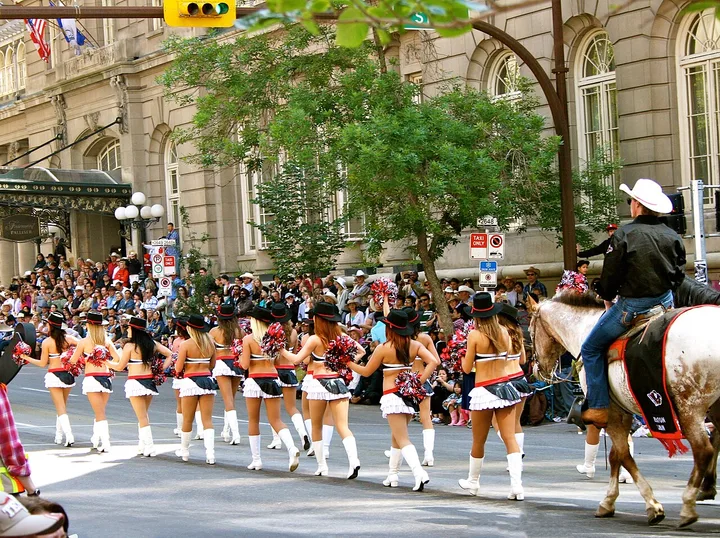
16. The first Stampede in 1912 was a one-off. American trick roper Guy Weadick organised it with backing from four local businessmen, offering $16,000 in prizes. Tom Three Persons made a famous bronc ride on a horse called Cyclone. The show did not return until a Victory Stampede in 1919, and it became an annual event after joining the agricultural exhibition in 1923, the same year chuckwagon races began.
17. The Calgary Tower became an Olympic torch. In 1987 a natural gas cauldron was installed on top so the tower could serve as an official Olympic flame for the 1988 Winter Games, and a hand-held replica of the tower was carried across Canada in the torch relay. The tower opened in 1968 as the Husky Tower and was renamed on November 1, 1971.
18. Calgary's Olympics made underdogs famous. At the 1988 Games, British ski jumper Eddie the Eagle became a fan favourite at Canada Olympic Park, and the Jamaican bobsled team's story later inspired the film Cool Runnings. The Olympic Oval at the University of Calgary earned a reputation as the fastest ice in the world.
19. The Flames did something no team had done. When Calgary won the 1989 Stanley Cup in Game 6 in Montreal, it became the first visiting team to beat the Canadiens for the Cup on Montreal Forum ice.
20. A country star was almost a children's nurse. Calgary-born singer Paul Brandt won $1,000 in a talent contest at the Calgary Stampede in 1992 while he was pursuing a career as a pediatric nurse. Music won, and his debut album came out in 1996.
Sources: Calgary Stampede, The Canadian Encyclopedia · Tower history, Calgary Tower · How to experience Calgary's Olympic legacy, Tourism Calgary · Stanley Cup champions 1980 to 1989, NHL.com · Paul Brandt, The Canadian Encyclopedia
Odd and impressive bits of city life
21. You can cross downtown without going outside. The Plus 15 network has 86 enclosed bridges and more than 16 km of walkways above street level, which is why office workers may not touch a sidewalk all winter.
22. The CTrain is counted as wind-powered. Since 2001 the City has bought wind-generated electricity equal to what the light rail system uses.
23. Calgary elected a groundbreaking mayor. Naheed Nenshi, elected in 2010, became the first Muslim mayor of a major North American city. He won the World Mayor Prize in 2014.
Sources: Plus 15 network, City of Calgary · CTrain, The Canadian Encyclopedia · Calgary, The Canadian Encyclopedia
Calgary fun facts at a glance
| Year | Fact |
|---|---|
| 1875 | The Mounted Police post is briefly called Fort Brisebois |
| 1876 | Renamed Fort Calgary after Calgary House on the Isle of Mull |
| 1886 | Fire leads to the sandstone era downtown |
| 1911 | Historic City Hall opens with jail cells in the basement |
| 1912 | First Calgary Stampede |
| 1930s | Dinny the dinosaur is built at the zoo |
| 1969 | The Caesar cocktail is invented; the first Plus 15 bridge opens |
| 1988 | Calgary hosts the Winter Olympics |
| 1989 | The Flames win the Stanley Cup in Montreal |
| 2001 | The CTrain switches to wind-powered electricity |
| 2020 | The $1.2 billion hailstorm |
Sources: Fort Calgary, The Canadian Encyclopedia · The great fire of 1886 and the birth of sandstone buildings, City of Calgary Newsroom · The making of Historic City Hall, City of Calgary · Calgary Stampede, The Canadian Encyclopedia · Dinosaurs, dancing and the birth of a prehistoric park, City of Calgary Newsroom · Caesar cocktail, The Canadian Encyclopedia · Plus 15 network, City of Calgary · How to experience Calgary's Olympic legacy, Tourism Calgary · Stanley Cup champions 1980 to 1989, NHL.com · CTrain, The Canadian Encyclopedia · Insurers to pay a record $1.2 billion after the Calgary hailstorm, Insurance-Canada.ca
Questions about Calgary trivia
Why is Calgary called Calgary?
James Macleod of the North-West Mounted Police named Fort Calgary in 1876 after Calgary House, a castle on the Isle of Mull in Scotland that he had visited in 1872.
What does the word Calgary mean?
The meaning is debated. It was once thought to be Gaelic for clear running water, but it is now generally said to mean bay farm.
Source: 7 names for Calgary before it became Calgary, CBC News
What is the Blackfoot name for Calgary?
The Blackfoot name is Moh-kins-tsis. The Îethka Nakoda Wîcastabi call the area Wicispa Oyade, the Tsuut'ina call it Guts-ists-I and the Métis call it Otos-kwunee.
Was the Caesar invented in Calgary?
Yes. Walter Chell invented the Caesar at the Calgary Inn in 1969 to celebrate the opening of its Italian restaurant, Marco's.
Was ginger beef invented in Calgary?
Ginger beef is said to have been invented by chef George Wong at Calgary's Silver Inn restaurant in the 1970s. It is the most widely told origin story, and the dish was first called deep-fried shredded beef in chili sauce.
Why are so many old Calgary buildings made of sandstone?
After a fire destroyed about 18 buildings in November 1886, town leaders pushed for fire-resistant buildings, and builders used local Paskapoo sandstone from 16 quarries around Calgary.
Source: The great fire of 1886 and the birth of sandstone buildings, City of Calgary Newsroom
When was the first Calgary Stampede?
The first Calgary Stampede was held in 1912, organised by Guy Weadick. It became an annual event after joining the agricultural exhibition in 1923.
What was the Calgary Tower originally called?
It opened in 1968 as the Husky Tower and was renamed the Calgary Tower on November 1, 1971.
Source: Tower history, Calgary Tower
How fast can a chinook change the temperature?
Very fast. A rise of 27 degrees Celsius in two minutes has been observed in Alberta's chinook belt.
How big was the Calgary hailstorm of 2020?
The June 13, 2020 storm caused almost $1.2 billion in insured damage in Calgary and nearby communities, the fourth most expensive insured natural disaster in Canadian history at the time.
Source: Insurers to pay a record $1.2 billion after the Calgary hailstorm, Insurance-Canada.ca