Checked
History of Calgary, Alberta
Calgary, Alberta, Canada
The history of Calgary, Alberta from thousands of years of Indigenous life at the confluence through Treaty 7, Fort Calgary, the railway, the sandstone boom, oil, the 1988 Olympics and recent floods.
Key information
People have gathered where the Bow and Elbow rivers meet for at least 12,000 years, and the area lies in Treaty 7 territory, signed in 1877 by the Blackfoot Confederacy, Stoney Nakoda and Tsuut'ina nations. The North-West Mounted Police built Fort Calgary there in 1875, the railway arrived in 1883, Calgary became a town in 1884 and a city in 1894.
On this page
Indigenous peoples at the confluence
The oldest evidence of people in the Calgary area is about 12,000 years old: spear points found in fields east of the city, left as glaciers retreated from the Bow valley at the end of the last ice age. Over the next 10,000 years several cultures lived and hunted here. Archaeologists have found campsites, bison kill sites, fireplaces and tipi rings more than 4,000 years old, as well as medicine wheels and cairns.
The Blackfoot have lived in the region for roughly 2,000 years. The Tsuut'ina arrived from the north in the 1700s and the Stoney Nakoda came later from the east. The meeting of the Bow and Elbow rivers was a natural gathering place, which is reflected in its names: Moh-kins-tsis in Blackfoot, Wicispa Oyade in Stoney Nakoda, Guts-ists-I in Tsuut'ina, and Otos-kwunee among the Métis. The Confluence Historic Site, on the old fort grounds, now tells that 12,000-year story rather than only the 39 years the fort operated.
Sources: Calgary, The Canadian Encyclopedia · Our city and land acknowledgement, City of Calgary · Renaming Fort Calgary, The Confluence Historic Site and Parkland
Treaty 7 and the land acknowledgement
Treaty 7 was signed on September 22, 1877, by five First Nations: the Siksika, Kainai and Piikani of the Blackfoot Confederacy, the Stoney Nakoda and the Tsuut'ina. The Crown's negotiators were David Laird and NWMP commissioner James Macleod. It was the last of the numbered treaties with the Plains nations. The Canadian Encyclopedia notes that the two sides had very different understandings of what was agreed, that language and cultural barriers were serious, and that this has led to conflicts and claims that continue today.
The City of Calgary's land acknowledgement recognizes the traditional territory of the Blackfoot Nations (Siksika, Piikani and Kainai), the Îethka Nakoda Wîcastabi First Nations (Chiniki, Bearspaw and Goodstoney) and the Tsuut'ina First Nation. It also recognizes Calgary as homeland to the Métis, the Otipemisiwak, including the Nose Hill Métis District and the Elbow Métis District within the Battle River Territory.
Sources: Treaty 7, The Canadian Encyclopedia · Our city and land acknowledgement, City of Calgary · Land acknowledgment, Calgary Public Library
Fur traders, bison hunters and whisky posts
The first Europeans came with the fur trade. David Thompson of the North West Company wintered near Calgary in 1787, and Peter Fidler travelled near the area in 1792. By the late 1860s American bison hunters and illegal whisky traders were moving north, building fortified posts in southern Alberta to trade alcohol for bison robes. One of those posts stood near today's Glenmore Reservoir. The damage caused by the whisky trade was one reason Ottawa created the North-West Mounted Police in 1873.
Sources: Calgary, The Canadian Encyclopedia · Treaty 7, The Canadian Encyclopedia
Fort Calgary and how the city got its name
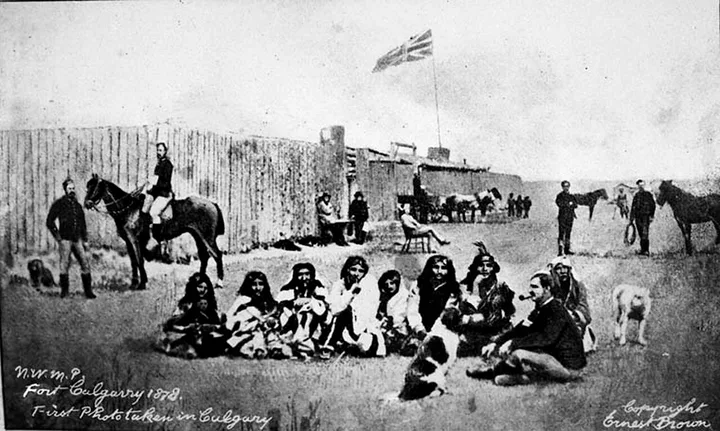
In 1875 Inspector Éphrem Brisebois led F Troop of the NWMP north from Fort Macleod to build a post where well-used trails crossed the Bow near the Elbow. The men built a log stockade themselves, with stables for 50 horses, and Brisebois began calling it Fort Brisebois. The name, and its owner, were unpopular. In June 1876 the post became Fort Calgary at the suggestion of Assistant Commissioner James Macleod, who named it after Calgary House, a castle on Scotland's Isle of Mull that he had visited. Brisebois resigned not long after.
The word Calgary is Gaelic, but its meaning is disputed. It was thought at the time to mean clear running water; most sources now say bay farm, and The Canadian Encyclopedia also lists Kali's garden as a possibility.
Fort Calgary became a district headquarters in 1882, but the railway and the growing town soon made it less important. The land was sold in 1914 to the Grand Trunk Pacific Railway, which tore down the buildings. The site was named a National Historic Site in 1925, bought by the City in the 1970s and opened as a museum in 1978. On May 2, 2024, the society that runs it changed its name to The Confluence Historic Site and Parkland and received the Blackfoot name I'táámito'táaattsiiyio'pi.
Sources: Fort Calgary, The Canadian Encyclopedia · Fort Calgary, Galt Museum and Archives NWMP exhibit · 7 names for Calgary before it became Calgary, CBC News · Renaming Fort Calgary, The Confluence Historic Site and Parkland
The railway, the town and the sandstone city
The Canadian Pacific Railway reached Fort Calgary in 1883 and laid out its townsite west of the Elbow and south of the Bow, where downtown still stands. Calgary was incorporated in 1884 as the first town in what is now Alberta, and it became a city in 1894. (Some popular histories say Calgary became a city in 1884; that was the year it became a town.)
On November 7, 1886, a fire that started behind a flour and feed store destroyed about 18 buildings on Atlantic Avenue, now 9 Avenue. Leaders then pushed for fire-resistant buildings, and Calgary turned to local Paskapoo sandstone. Sixteen quarries supplied hundreds of sandstone buildings over the next quarter-century, earning Calgary the nickname Sandstone City.
Ranching drove the early economy. Pat Burns, the city's first millionaire, built Canada's largest integrated meat business here. When farm settlement opened southern Alberta after 1900, Calgary grew by more than 1,000 per cent between 1901 and 1911. Streetcars started running in 1909, Historic City Hall opened in 1911, and in 1912 Guy Weadick staged the first Calgary Stampede.
Sources: Calgary, The Canadian Encyclopedia · The great fire of 1886 and the birth of sandstone buildings, City of Calgary Newsroom · The making of Historic City Hall, City of Calgary · CTrain, The Canadian Encyclopedia · Calgary Stampede, The Canadian Encyclopedia
Oil and the growth of a modern city
Oil changed everything. The 1914 strike at Turner Valley, southwest of the city, was promoted hard by local businessmen, Alberta's first oil refinery opened in Calgary in 1923, and bigger finds at Turner Valley in 1924 and 1936 made Calgary the centre of Canada's oil and gas business. When the huge Leduc discovery near Edmonton came in 1947, Calgary's offices were ready to manage the boom that followed.
Calgary grew steadily after the Second World War, dipping only in 1983 and 1984 when oil prices collapsed. The Husky Tower (now the Calgary Tower) opened in 1968, the first Plus 15 bridge in 1969 and the CTrain in 1981. The 1988 Winter Olympics brought the Saddledome, Canada Olympic Park and the Olympic Oval, and the Flames won the Stanley Cup a year later.
Sources: Calgary, The Canadian Encyclopedia · Tower history, Calgary Tower · Plus 15 network, City of Calgary · CTrain, The Canadian Encyclopedia · How to experience Calgary's Olympic legacy, Tourism Calgary · Stanley Cup champions 1980 to 1989, NHL.com
Recent milestones
In 2010 Calgary elected Naheed Nenshi, the first Muslim mayor of a major North American city. The Peace Bridge opened in 2012 and the Central Library in 2018, which the designers described as the city's largest public investment since the Olympics.
Nature has tested the city. The June 2013 flood forced about 80,000 people from their homes and caused as much as $6 billion in losses across southern Alberta, and the June 13, 2020 hailstorm caused almost $1.2 billion in insured damage. On June 5, 2024, a break in the Bearspaw South Feeder Main, a large pipe that carries much of the city's drinking water, led to water restrictions on and off until September 22, 2024. A second break followed on December 30, 2025, and work to replace the main continued through 2026.
Sources: Calgary, The Canadian Encyclopedia · Calgary's Peace Bridge, Canadian Consulting Engineer · Calgary's new library opens, Canadian Consulting Engineer · Flood history in Calgary, City of Calgary · Insurers to pay a record $1.2 billion after the Calgary hailstorm, Insurance-Canada.ca · Bearspaw South Feeder Main reviews and progress, City of Calgary
Historic places you can still visit
- The Confluence Historic Site and Parkland, 750 9 Avenue SE, on the grounds of Fort Calgary.
- Historic City Hall, the sandstone city hall opened in 1911, a National Historic Site of Canada since 1984.
- Stephen Avenue (8 Avenue SW), a national historic district since 2002, lined with sandstone and brick buildings from the boom years.
- Heritage Park Historical Village, which celebrates Calgary's early history as a Mounted Police post and ranching centre.
- The Calgary Tower, opened in 1968, and Olympic venues such as the Saddledome and the Olympic Oval.
Sources: Renaming Fort Calgary, The Confluence Historic Site and Parkland · The making of Historic City Hall, City of Calgary · Calgary, The Canadian Encyclopedia · Tower history, Calgary Tower · How to experience Calgary's Olympic legacy, Tourism Calgary
Calgary history timeline
| Year | Event |
|---|---|
| About 12,000 years ago | Earliest evidence of people in the Calgary area |
| 1787 | David Thompson winters near Calgary |
| 1875 | NWMP build a post at the Bow and Elbow confluence |
| 1876 | The post is renamed Fort Calgary |
| 1877 | Treaty 7 is signed on September 22 |
| 1883 | The Canadian Pacific Railway arrives |
| 1884 | Calgary is incorporated as a town |
| 1886 | Fire destroys about 18 buildings; the sandstone era begins |
| 1894 | Calgary becomes a city |
| 1911 | Historic City Hall opens |
| 1912 | First Calgary Stampede |
| 1914 | Oil strike at Turner Valley |
| 1923 | Alberta's first oil refinery opens in Calgary; the Stampede becomes annual |
| 1968 | Husky Tower (Calgary Tower) opens |
| 1981 | CTrain light rail begins service |
| 1988 | Calgary hosts the Winter Olympics |
| 2013 | Major flood on the Bow and Elbow rivers |
| 2020 | Hailstorm causes almost $1.2 billion in insured damage |
| 2024 | Fort Calgary site renamed The Confluence; Bearspaw feeder main breaks |
Sources: Calgary, The Canadian Encyclopedia · Fort Calgary, The Canadian Encyclopedia · Treaty 7, The Canadian Encyclopedia · The great fire of 1886 and the birth of sandstone buildings, City of Calgary Newsroom · The making of Historic City Hall, City of Calgary · Calgary Stampede, The Canadian Encyclopedia · Tower history, Calgary Tower · CTrain, The Canadian Encyclopedia · Flood history in Calgary, City of Calgary · Insurers to pay a record $1.2 billion after the Calgary hailstorm, Insurance-Canada.ca · Renaming Fort Calgary, The Confluence Historic Site and Parkland · Bearspaw South Feeder Main reviews and progress, City of Calgary
Questions about Calgary history
When was Calgary founded?
The North-West Mounted Police built a post at the meeting of the Bow and Elbow rivers in 1875, renamed Fort Calgary in 1876. Calgary was incorporated as a town in 1884 and as a city in 1894.
Who founded Calgary?
Inspector Éphrem Brisebois and F Troop of the North-West Mounted Police built the post in 1875. Assistant Commissioner James Macleod gave it the name Calgary in 1876.
What treaty is Calgary on?
Calgary is in Treaty 7 territory. Treaty 7 was signed on September 22, 1877, by the Siksika, Kainai, Piikani, Stoney Nakoda and Tsuut'ina nations.
Whose traditional land is Calgary on?
The City of Calgary acknowledges the territory of the Blackfoot Nations, the Îethka Nakoda Wîcastabi First Nations and the Tsuut'ina First Nation, and Calgary as homeland to the Métis, the Otipemisiwak.
Why was Fort Calgary first called Fort Brisebois?
Its commander, Inspector Éphrem Brisebois, named it after himself. His superiors objected, and Macleod renamed it Fort Calgary in June 1876.
When did the railway come to Calgary?
The Canadian Pacific Railway reached Calgary in 1883 and laid out a townsite west of the Elbow River and south of the Bow, where downtown is today.
What happened in the Calgary fire of 1886?
On November 7, 1886, a fire destroyed about 18 buildings on Atlantic Avenue (now 9 Avenue). Afterwards major buildings were built of local sandstone.
Source: The great fire of 1886 and the birth of sandstone buildings, City of Calgary Newsroom
When was oil discovered near Calgary?
The first major strike was at Turner Valley, southwest of Calgary, in 1914. Alberta's first oil refinery opened in Calgary in 1923.
What is Fort Calgary called now?
On May 2, 2024, the society that runs the site became The Confluence Historic Site and Parkland and received the Blackfoot name I'táámito'táaattsiiyio'pi.
Source: Renaming Fort Calgary, The Confluence Historic Site and Parkland
When was the big Calgary flood?
The largest recent flood was in June 2013. About 80,000 people were evacuated, and floods of similar size had occurred in 1879, 1897 and 1902.